
Paper or Plastic: A Study on Single-use and Sustainability
A Guest Blog by William G. Whitford, Strategic Solutions Leader BioProcess, GE Healthcare Life Sciences
What is sustainability?
For some, the special meaning of the word in this application is how biological systems remain diverse and productive over time. In this way, sustainability is not just about saving resources or avoiding pollution within a narrow context – it’s more of a long-term holistic approach to our ecological-relevant activities. For others however, the term is used to include all environmental concerns, including those of a more immediate or non-biological focus; examples here might be a town’s solid waste disposal or a nations mineral resource depletion. Other factors here can include local environmental connotations or immediate, acute concerns. The concept of sustainability has developed to often include three “pillars”:
- Cultural preservation and social equity
- Economic development and technological progress
- Environmental consciousness and resource conservation
It’s rather obvious that all of these factor into mutually-interdependent relationships. But, what is rather surprising is that there is no real consensus on the precise definition of, and goals in, each pillar (1). Beyond such personal considerations of individuals, rather deep theories and ideologies have been developed in the field (2). Common themes within each of them include:
- Addressing the consequences of our activities on natural processes
- Preserving what elements of the natural environment we have left
- Understanding and respecting the importance of individual cultures
- Respect and value of diversity and redundancy in biological systems
- Value and support the ways to promote social well-being and equity
So, it seems the best approach is to limit disputes on terminology, but instead to focus on the good science and economic opportunity available and to achieve a greater harmony between our economic, cultural and environmental demands (3, 4).
What are the individual categories of environmental stress or footprint?
Which are most important? These are very interesting questions. There have been at least 20 specific types of environmental concerns identified, each with their own sub-type. They include such things as terrestrial ecotoxicity, acidification and transformation; marine ecotoxicity and eutrophication (hypertrophication); freshwater depletion, ecotoxicity and eutrophication; and ozone depletion. As to which are most important, a significant question here is “to whom and with what assumptions”., even sincere participants in the debate can come to different conclusions on which activity to choose. An example here is in power generation: coal contributes to carbon, particulate and acids pollution, whereas nuclear contains a threat of disastrous radioactive pollution. The proper choice between the two depends upon ones greatest concern. The very recent conviction of a wind-power generation company for killing protected birds illustrates this challenge (5).
Why is it important to consider?
All agree that pollution causes ugliness, disease, dysfunction and expense. And, beyond the long-term “sustainability” issues, there are short-term costs of pollution. Finally, there are the regulatory demands. Concerned or not, there are laws and regulations that apply to many business activities. It must be acknowledged that some have employed the label ‘green’ or ‘sustainable’ either to placate those truly concerned, or in an attempted to gain a marketing advantage. On the other hand, some biopharmaceuticals and suppliers take the challenge seriously and strive to genuinely promote sustainability in a number of ways. For example, Thermo Fisher Scientific’s facilities operate under a program that generally follows the ISO 14001 environmental management standard. And, it establishes additional requirements within its own policies as it develops eco-friendly operations and products. It partners with customers, industry and the scientific community to advance environmental management and science. Where reasonably feasible it finds alternatives to RoHS-banned substances (Directive 2011/65/EU) and has established recycling for a growing number of products sold in a growing number of locations. This includes returning some to Thermo Fisher facilities. Finally, it has appointed corporate officers to direct environmental impacts of its policies and coordinate continued conservation initiatives.
How do we best assess a technologies sustainability?
The science of Lifecycle Analysis or Assessment (LCA) is now the approach of choice when making such assessments (6, 7, 8). This “cradle-to-grave” analysis is a method to comprehensively quantify and interpret all environmental impacts associated with a product, process, or service’senergy and material flows. It considers them from raw material production through intermediate materials processing, manufacture, distribution, maintenance and use– to disposal, recycling or re-purposing. Outputs here include emissions to air, water, and land and inputs include consumption of energy and material resources. ISO 14040:2006(9) and ISO 14044:2006(10), describe a four-stage methodology for executing an LCA. It is common to identify three life cycle stages (supply chain, use and end-of-life). Use of an LCA aids in avoiding an inaccurately narrow outlook on the environmental stress of a particular activity by:
- Listing all relevant energy and material inputs and environmental output
- Evaluating the environmental consequences of these inputs and outputs
- Analysis and interpretation of such values yielding more useful decisions
How do single-use systems currently measure up?
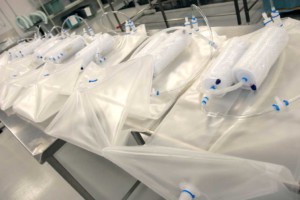 Much has been accomplished on this topic, and we now know quite a bit about the environmental stress cause by single-use (SU) as compared to conventional steel facilities. Most advanced studies result in the conclusion for the majority of installations, there is a reduction in the environmental foot print, or ecological stress, in environmental impact. Very rigorous comparative analysis indicates that single-use bioprocessing technology exhibits lower environmental impacts, compared to conventional bioprocessing technology, in all impact categories examined. From terrestrial ecotoxicity, to marine eutrophication, to ozone depletion– in the long run SU-based manufacturing is more environmentally friendly. For example, it’s been reported that a single-use technology facility is in the order of 50% less energy intensive than one based on conventional stainless steel. This is primarily because the heating of highly-processed water to clean and sterilize the reusable equipment consumes more energy than producing and disposing of plastic containers. Furthermore, a user can elect to recycle or re-purpose the containers– such as by incinerating them for energy recovery (11). Other calculations suggest that going single-use results in an about 85% reduction in water usage and waste generation (12). The most comprehensive analysis, including LCA approaches, show that while SU facilities are in fact more “green”, the overall impact of single-use technologies on, for example, waste flow is reduced over the plant’s life-cycle (13). One study showed that over the full life cycle of production, the energy demand and global warming potential for production in single-use systems is 30 – 35% lower that for a stainless steel facility, respectively (14). Here it was suggested that some intermediate environmental stress category values are slightly higher for single-use as compared to conventional process technology. This is mostly due to the increased manufacturing required to provide the single-use consumable components. However, as supply chain impacts represent only a small fraction of these categories total life cycle impact, the final result is that SU provides less overall impact. It’s of note that these studies are on SU technology as it exists today. Being relatively new, one might imagine that economies of scale and advancements in manufacturing engineering will increase production efficiency, further reducing its environmental footprint. It is evident from such studies that, beyond the other many advantages to single-use, it contributes to a significantly smaller environmental footprint per kilogram of product produced than facilities using conventional stainless steel systems (15, 16).
How can we improve SU in this regard?
The best analyses show that right now the use of SU doesn’t conflict with sustainability goals but is actually superior to the stainless steel engineering it replaces. Nevertheless, there are still areas of desired improvement. Many would like to reduce the environmental stress caused by disposal of used plastic containers. New approaches to the problem of repurposing or recycling the plastic waste from continually arise. None are a perfect solution, but each can ameliorate stress in particular categories of environmental impact. One suggestion is to repurpose the plastic into such products as architectural beams (17). Another example, plasma gasification, uses a plasma torch to ionize gas and catalyze organic matter into synthetic gas. One group operates a test facility of such technology in Ottawa, Canada and has recently announced plans to construct a commercial-scale plant (18). This note has focused on SU-specific issues, but highly related issues include facility design, and general biopharmaceutical sponsor sustainability initiatives (19). Finally, it should be acknowledged that as with many technologies, even greater increases in the eco-friendliness of SU could result from more focused and comprehensive sustainability programming. For SU this could potentially come from such suppliers groups as the BPSA or users groups as BPOG.
Author’s Bio
 Bill Whitford is Sr. Market Manager, Cell Culture for Thermo Scientific Cell Culture and Bioprocessing in Logan, UT with over 20 years experience in biotechnology product and process development. He joined the company nine years ago as a team leader in R&D developing products supporting biomass expansion, protein expression, and virus secretion in mammalian and invertebrate cell lines. Products he has commercialized include defined and animal product-free hybridoma media, fed-batch supplements, and aqueous lipid dispersions. An invited lecturer at international conferences, Bill has published over 200 articles, book chapters and patents in a number of fields in the bioproduction arena. He now enjoys such industry activities as serving on the editorial advisory board for BioProcess International and the Journal of Virology and Biotechnology.
Author’s Particulars:
William G. Whitford
Strategic Solutions Leader
BioProcess
GE Healthcare Life Sciences
925 West 1800 South Logan
Utah 84321
Direct: 435-792-8277
Mobile: 435-757-1022
Facsimile: 435-792-8018
bi
*This content has been updated since the first publication to reflect the author’s current affiliation. The author’s previous affiliation was Senior Manager, Bioprocessing Market, Thermo Fisher Scientific
Footnotes
-
1. The Sustainability Problem
-
2. Ecosystems and Human Well-being, World Health Organization 2005
-
3. http://www.developforthelongterm.com/the-sustainability-problem.html
-
4. IPCC, Climate Change 2007: The Physical Science Basis. Contribution of Working Group I to the Fourth Assessment Report of the Intergovernmental Panel on Climate Change, (Solomon, S., et al. Eds.) Cambridge University Press, Cambridge, UK, and New York, USA (2007).
-
5. Guilty plea in bird deaths at wind farms a first.
-
6. Wayne TrustyICC BSJ Online: An Overview of Life Cycle Assessments-Part One Monday, October 18, 2010,
-
7. Jungbluth, N. and Frischknecht, R. Implementation of life cycle impact assessment methods - Chapter 2: Cumulative Energy Demand. Ecoinvent report No. 3, Swiss Centre for LCI, Dübendorf, CH (2010)
-
8. Goedkoop, M., ReCiPe 2008: A life cycle impact assessment method which comprises harmonized category indicators at the midpoint and the endpoint level. VROM–Ruimte en Milieu, Ministerie van Volkshuisvesting, Ruimtelijke Ordening en Milieubeheer (2009).
-
9. ISO, 2006a, ISO 14040 - Environmental management - life cycle assessment - Principles and framework, International Organization for Articlesization.
-
10. ISO, 2006b, ISO 14044 - Environmental management - life cycle assessment - Requirements and guidelines, International Organization for Articlesization.
-
11. Rawlings B, Pora H. Environmental Impact of Single-Use and Reusable Bioprocess Systems. BioProcess Int. 7(2) 2009: 18–26.
-
12. Hodge G. The Economic and Strategic Value of Flexible Manufacturing Capacity. ISPE Strasbourg Conference, 28–29 September 2009, Strasbourg, France.
-
13. Mauter M. Environmental Life-Cycle Assessment of Disposable Bioreactors. BioProcess Int. 8(4) 2009: 18–28.
-
14. Pietrzykowski M, et al. An Environmental Life Cycle Assessment Comparing Single-Use and Conventional Process Technology. BioPharm Int. 24(S1) 2011: 30–38.
-
15. W. Whitford, “Single Use Systems as Principal Components in Bioproduction”. BioProcess International, Vol. 8, No. 11, December 2010, pp. 34–42.
-
16. Howard L. Levine, Jan E. Lilja, Rick Stock, Hans Hummel, Susan Dana Jones . Efficient, Flexible Facilities for the 21st Century, BioProcess International 10(11)s December 2012.
-
17. Something on repurposing plastic into logs
-
18. Nate Seltenrich. Burning issue: 'Waste-to-energy' plants take off in bid to cut garbage, fuel use. November 2013 The Daily Climate.
-
19. Scott, C. Sustainability in Bioprocessing. BioProcess International 9(10) 25- 36, 2011.